
(reviewed by Monette Moradi)
Michael Halperin, Out Of The Storm: Holocaust To Hope, Cherry Orchard Books (Academic Studies Press), November 2025, 356 pgs
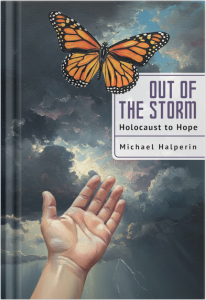
Antisemitism did not begin when Hitler became Chancellor of Germany, nor did it start with the pogroms of 19th-century Eastern Europe. Rather, as Michael Halperin establishes at the opening of his book, its roots reach back to Emperor Constantine and his adoption of Christianity throughout his empire, leading to the well-known blood libels holding the Jewish people responsible for the death of Jesus — a claim the Catholic Church would not formally denounce until 1965. As further preamble, we learn about the history of Jews in Poland and the successful attempts by the Polish aristocracy to integrate Jews into their social classes, while allowing them the freedom to practise their faith. But all of that changed when Germany invaded Poland in 1939.
Out Of The Storm: Holocaust To Hope is not simply a work of nonfiction centred on the history of the region, though that history serves as an important backdrop to what the Roslan family were pushing back against when they decided to rescue three brothers from the Warsaw Ghetto — an act of resistance against the German occupation and a matter of moral duty. It is a true story about the risks Alex Roslan took and the lengths he and his family went to, not only to survive but to ensure that Shalom, David, and Jacob Gutfeld could live in a world that guarantees the safety of all Jewish people. Those lengths are both emotional and physical, during and after the Holocaust. Along the way, Halperin’s cinematic writing conveys not only the enormous stakes the Roslan family took on — as partisans and as righteous gentiles — but also the antisemitism that remained prevalent among the Polish and wider European community, despite everything the European Jewry endured and that was well documented by the war’s end.
What sets Halperin’s research apart from other righteous gentile narratives is his spotlight on the Roslans’ determination to ensure their charges could reconnect with their remaining family in the forming State of Israel. In our own times, the ancient blood libels have been renewed. The imagery of Jesus’s blood libel has been co-opted by the anti-Zionist movement to justify the erasure of Israel as a state. What Halperin is able to do is give the reader hope — to remind us that in Israel there are trees planted in memory of the gentiles who saved Jewish lives despite what they were supposed to believe as Christians. That true acts of faith from non-Jews means understanding that the Jewish people wish to live in their own land in peace, as told to us by Hashem, and that until the day comes when this is possible for all Jews, it is their duty to be good hosts and allow them the freedom of choice in where and how they practise their existence.