 (reviewed by Monette Moradi)
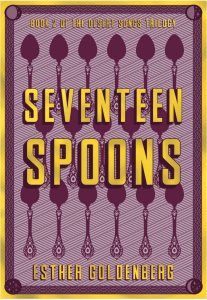
Esther Goldenberg, Seventeen Spoons: The Desert Songs Trilogy, Book 2, 100 Block by Row House Publishing, March 2025, 432 pgs.
Judaism began as an oral tradition before it was committed to writing. For generations, we trusted our rabbis and elders to transmit the stories and laws they had received from the authorities of their own time, and so on backward, until the chain reached the Patriarchs themselves. In Seventeen Spoons, the second book of Esther Goldenberg’s Desert Songs Trilogy, this motif of transmission takes centre stage: the telling and retelling of our forefathers’ stories so that tradition passes unbroken from one generation to the next.
The narrator here is Yosef, son of the forefather Yaakov. Most readers will know him in outline: the dreamer whose brothers sold him into Egypt, the father of two of the twelve tribes. But Goldenberg does not begin where we might expect, from Yosef’s own vantage point looking outward. Instead, she traces his life from birth to death, taking the same creative liberties she employed in The Scrolls of Deborah. While familiarity with that first book is not essential, readers will benefit from knowing its title character, who reappears here at the midpoint.
Two aspects stand out. First, Goldenberg weaves lines from the Torah into her narrative so seamlessly that the ancient text feels newly alive. Second, and more significantly, the expanded backstories and invented dialogue do genuine interpretive work: they illuminate characters’ motivations and open space for debate about the moral ambiguity of their choices. This applies not only to Yaakov, Yosef, and his brothers but also to figures often left in shadow. Rachel’s ethically fraught decision to steal her father’s idol receives fuller treatment, as does Dinah, who in the biblical account is known only as a victim. In Goldenberg’s telling, Dinah possesses agency; she makes choices and understands their consequences, rather than simply enduring what befalls her.
It should be noted that this instalment addresses more explicit subject matter than its predecessor, including same-sex relations, miscarriage, and sexuality more broadly. None of this diminished my engagement. If anything, I found myself more absorbed, particularly in attempting to interpret the dreams scattered throughout the narrative, beyond those already familiar from the Torah. Goldenberg has laid the groundwork for the trilogy’s final volume, and readers who have followed her this far will want to see what she draws next from the details in our sacred texts that we too often take for granted.