
(reviewed by Monette Moradi)
Barbara Krasner, The Color of Time and Other Stories, BlazeVOX Books, August 2025, 138 pgs
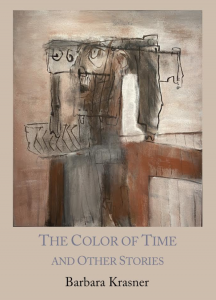 Jewish stories invariably tell the history of our people. Whether fiction or testimony, they provide an outlet to articulate our pain, for ourselves and for a wider community. Within all Jewish stories lie invisible threads that connect them, forming a larger mosaic of what it means to live as an openly Jewish person today. Barbara Krasner’s The Color of Time and Other Stories exemplifies these connecting threads that reverberate throughout the Jewish experience. Though entirely fictional, Krasner’s stories feel authentic because of her skill in rendering the people at their center. Focused on the pre- and post-Holocaust experience of Jews, each character feels inhabited: the survivor adjusting to 1950s America, the son of a Dutch Nazi collaborator, the fictional “Last Living Holocaust Survivor.” These stories speak truths about unknown Jewish lives and families whose own accounts may never be shared.
The opening story, “Tesserae,” bookends the title story (“The Color of Time”) with deliberate symmetry. It follows Yankl Dovid, a Polish Jew making the wrenching decision to flee Nazi-occupied Poland and begin life anew in an unnamed destination. The story’s title refers to the mosaic tiles adorning the mezuzah of their home, one of the few personal items they carry into their new existence. Here the thematic foundation is established. For the reader, these tiles become a metaphor for the book’s interwoven themes. Each tile represents a story, fictional or otherwise, forming a pattern of Jewish peoplehood that began millennia ago.
At the other end stands the title story, which centers on an artist performing in the Catskills circa 1966. With Chagall as his guiding star, the painter experiences a vivid dream that reimagines the Jewish people beyond their role as perpetual prey within the world’s fabric. Instead, they appear as liberated spirits embracing all facets of life, including pain.
Suffering has long been considered the sole thematic thread of Jewish identity. While Krasner’s stories certainly depict this suffering in their vignettes of life, equally present is an embrace of origin and a duty to assert Jewish identity as a talisman against future adversity. This imperative applies to whatever obstacles or adversaries the Jewish people face, and Krasner communicates it masterfully across these stories.