
Almost 38 years, to the day, before my father stopped breathing in the intensive care unit of a South Carolina Hospital, he brought me to Yankee Stadium for opening day. The Bronx Bombers played the defending World Series champions, the Kansas City Royals. I’d been to the stadium a few times, but that April 1986 day was my true initiation to mythos of the New York Yankees. In the Spring light, the green field seemed to stretch as far as the Great Plains.
I heard thousands of fans booing the home team and I asked my dad why.
“They’re not saying boo,” my dad said patiently. “They’re saying Lou.”
“Sweet” Lou Pinella, the popular and recently retired third baseman, made his debut as the Yankees Skipper that day.
My mother was not happy that I missed school. Nor was she thrilled that my father and I rode the graffiti-covered subway from Queens to the Bronx, switching lines at Grand Central Station in Manhattan. If television news was to be believed, he’d gambled with our lives to avoid sitting in traffic and paying for parking. I must believe that part of his motivation was wanting to give me the true New York experience of being crushed between people, hanging on for dear life while the clanking of cars on tracks overpowered the ears. Before entering the stadium, we stopped at one of the bars beneath the elevated train to meet one of his British Airways friends. I found the smell of beer pungent but loved the celebratory pre-crowd and felt I’d momentarily gained entry to my father’s world.
If my father, Robert Edward Schwartzman, tried to impart any religion, it was his faith in the Yankees. Ruth, DiMaggio, Mantle, Berra, Ford and Munson were his patriarchs. Yankee Stadium was his congregation. It even had its equivalent to the Holy of Holies, Monument Park, beyond centerfield. The physical testaments to the Yankee greats had once, incredibly, resided on the field of play, allowing the possibility for an outfielder to collide with stone, or for the ball to land behind one while a runner sprinted the basepath. By 1986, before each game, fans could marvel at stone plaques in a small park just beyond center field. Though we didn’t get there that day — it closes about an hour before gametime — I could see the park from our seats, like some restricted shrine.
Recently, I had a chance to revisit Monument Park in the new Yankee Stadium, opened in 2009, a couple of hundred yards from the original. Hallowed ground, apparently, is mobile. As I ambled past plaques displaying legendary names and likeness, I couldn’t help but think about my father, whose gravestone was unveiled a few months earlier, about a year after his death. Each Yankee plaque, I thought, resembled a grave marker. Though I was certain no bodies lay beneath my feet, it was as if the space were haunted by ghosts. Whether it was the specters of the players or the memories and ancestors of visitors like me, I didn’t know.
I’ve never given much thought to gravestones and haven’t made many cemetery pilgrimages, even though I’d grown up in Queens, Manhattan’s onetime burial ground. Queens has roughly two million residents. Once I heard that the borough has more deceased residents than living ones. I have not visited the resting places of luminaries in my home borough like Yiddish author Shalom Aleichem or the Lubavitcher Rebbe, Menachem Mendel Schneerson. I haven’t been to my grandparents’ graves in Long Island and New Jersey, respectively, since their funerals, the last of which was in 1998. Only recently did I make it back to my cousin’s tomb. He went to work on Sept. 11, 2001, and never came home. Nearly a quarter century later, his mother was buried alongside him, and I stood alongside my mother and aunt, witnessing Aunt Linda’s casket lowering into the earth. My father-in-law lay buried 300 miles to the north. Only twice in the 18 years since his passing have my wife or I followed the ancient Jewish custom of murky origins and laid a stone on his grave.
The physical properties of gravestones convey both permanence and impermanence. They are tangible markers of life departed from the physical world. Whether or not there’s a world to come, one knows that a gravestone stone marks the spot of bones. Gravestones are places to visit when the real place we’d like to visit lies in our memories or the impossible-to-reach past.
After my father died, I felt it was my duty to plan the funeral and the eulogy. Don’t all sons who consider themselves writers spend years drafting their father’s eulogies in their heads? Unless the natural order is reversed, sooner or later, most sons have to bury their fathers. This leads to the most ordinary, expected kind of grief. Yet no matter how long my father and I cohabited the world, how much we’d said to each other, how much progress we’d made, how many arguments, the relationship didn’t feel finished. One grieves for what was and what wasn’t.
The story of a father and son is the story of two lifetimes. What could begin to contain such emotions? Perhaps the story of how my father, a lifelong New Yorker with a second home in South Carolina, came to rest in Chester County, Pa. And of the words and images that mark his burial site in an anonymous suburb of an unfamiliar city.
***
My bedroom floor rattled, sounding like a jackhammer. I wondered if our washing machine had decided, once again, to shake across the floor. But none of my household appliances had moved an inch. About 15 minutes later, a news alert revealed that a magnitude 4.8 earthquake struck near Whitehouse Station, New Jersey, on April 5, 2024, at 10:23 a.m. That’s about 43 miles northeast of our house in Montgomery County, Pa. I worked from home that day and needed to share my disbelief and momentary fright with someone. My wife, who frequently works at home as well, had taken my mother-in-law to a doctor’s appointment. Suddenly, I knew I needed to tell my father. He was in Myrtle Beach, where my parents spent about half the year. Normally, he instantly answered, unless he’d had his hearing aid out or had stepped too many paces from the phone. I called and got no answer. A few minutes later, I rang his cell again and heard my mother’s voice.
“Dad’s not feeling well,” she said calmly. “He’s in the bathroom. He’s complaining about his back and neck. I’m taking him to the emergency room.”
Back, neck and cough didn’t seem like it added up to a need for a hospital. But that’s where she was taking him, if she could get him out the door and into the car.
“Call an ambulance,” I said.
She didn’t. In our family, ambulances are like therapists; we don’t use them even when we should. Still, she managed to drive my father to the closest hospital.
****
My father grew up in a walk-up apartment just outside the Parkchester section of the Bronx and spent almost all of it his life in New York City. He graduated from James Monroe High School, worked for a watch factory, and briefly served his country in the U.S. National Guard. In 1963 or 64, he went to work in British Airways’ New York office, where he remained until he was forced to retire in 2001. He and my mother were married just shy of 55 years. He bowled, played softball in the airline employees league, shoveled snow for elderly neighbors and became a watchful uncle of sorts to his younger co-workers. When he took me to see Mel Brooks’ Spaceballs he laughed so hard he fell out of his aisle seat, the thud heard over collective giggling. He watched thousands of Yankees games on television and probably attended dozens in person.
He started smoking at 13 or 14 and, as far as I know, finished his last pack at 55. For much of that time, the cumulative effects didn’t seem to slow him down. I think of my father moving, fixing a leaky faucet, putting with underneath the hood of a steel behemoth, or hitting a ball of one kind or another. I have a few 8-millimeter scenes of him in his teens and early 20s, mostly at Dutchess County, NY, country house my grandparents owned with my great aunt and uncle. In these images, he’s never still; the film added a jerky quality to his movement. The man I knew in his 30s, 40s and 50s played softball, went on ski trips with co-workers, shoveled snow, raked copious amounts of leaves at the pool club my mother managed, and beat me at tennis well after I’d started taking lessons. He could nimbly ascend any ladder or move any piece of furniture. Sure, he’d had his coughing fits. And, after a game or bike ride, he’d plop in his recliner for hours, hand attached to a remote or Pepsi, getting up only to step out the front door and light up.
Starting in his mid-50s, the bills all came due. First, there was the heart attack, which ironically came six months after he’d stopped smoking. He recovered enough that, briefly, before I left home for good, he became my hiking buddy, and we found a new subject to bond over and argue about. Were we following the trail and map correctly? Then, after I’d moved to Philadelphia, he was stricken with prostate cancer and diabetes. This was followed by emphysema and COPD, curtailing his activities and making him appear older than his years. Still, he lived surprisingly well until his mid-70s, travel, golf, time with friends and increasingly, his granddaughters. However, by 2021 or 2022, his quality of life had severely diminished; his overweight body wasn’t getting enough oxygen. Everything about him seemed to slow. He suffered hearing loss and didn’t like to wear aid, so he was often unable to follow conversations, especially those taking place at rapid fire, with voices coming from all directions. When he started suffering from incontinence, he became increasingly housebound and, I think, depressed.
Less than two weeks before his hospitalization, my wife, daughters and I visited my parents during the girls’ spring break. My father remained home during the day, while he visited an alligator farm, perused beach shops and survived an extremely loud children’s museum. On previous visits, he’d join us on outings but find a place to sit while the rest of us wandered. This time, he came along to the Carolina Opry, a kitschy performance of country and pop with a few comedy bits that wouldn’t land in New York or Philadelphia. That was the last evening of entertainment we’d enjoy together; it should have been something truer to the two of us, like a baseball game or Pink Floyd cover band. One night we sat in rocking chairs on the screened-in porch. We talked for 20 minutes without interruption. I don’t remember what we spoke about; just that there were no interruptions and neither of us yelled at or criticized the other.
Were we mismatched as father and son? Or, at least, a kind of father-son odd couple? He, so good with his hands, never, to my knowledge, completed a book. Me, valuing words and books perhaps too highly. Anytime he showed me how to do something mechanical —like, say, checking the oil on a car — I’d ask him to put into words. He couldn’t. Both student and teacher grew frustrated. Sometimes, he’d even ask if I was retarded. Later, that same man told me he loved me nearly every time we spoke. On the other hand, I rarely if ever offered to help him mow the grass or shovel a neighbor’s yard.
“Why didn’t you ask me?” I’d say after he’d mutter something.
“I shouldn’t have to ask.”
At times, it felt as if, to one another, we were each the most incomprehensible person in the world. Going to school after college with no goal other than to study Judaism and literature must have seemed beyond bizarre to someone who, quite rightly, valued what could put food on the table. The Yankees, classic rock, Star Wars and Star Trek: these common points and contact enabled us to communicate across indefinable barriers. He tried but couldn’t quite muster my passion for professional tennis. I reciprocated by ignoring the existence of golf.
When I met, became engaged to and married Amy, no one was happier than my father, the wedding photos show him red-faced and beaming. A married man with a job, a father: he could relate to this version of his son. And, as a parent, I could find new appreciation for my own parents, especially my father. For years, our relationship felt good, aided by distance and regular phone calls. Yet, when his health declined, when his hearing worsened and everything about him slowed, it got harder, especially as I was chasing my children or talking and doing things at top speed.
***
“Dad has pneumonia,” my mother told me by phone a few hours after taking him to the hospital.
He was sent by ambulance to a larger hospital about 25 minutes north. The Grand Strand Medical Center. Shortly after arriving, he was moved to an intensive care unit. I talked to him for a few minutes that evening, managing to share my earthquake experience. His voice was weak, but he sounded alert. My mother told me I didn’t need to make the trip to South Carolina. Parsing the words, she didn’t tell me not to come. Twenty-four hours later, Saturday night, he was still in the ICU. My mother sounded as if this were all no big deal, or at least no more severe than previous hospital stays. Something about her calm alerted me. I was overcome by a sense that I needed to be there. I needed to put work, marriage and fatherhood on temporary hold to be a son. I may not always have been the most respectful or considerate son. But I was his son. He needed me; for what, I wasn’t sure. And my mother might need me too.
***
The glass door to my father’s ICU room was open. There were airflow tubes running to his nose. His false teeth were removed, so the shape of his face looked concave. His skin was pale, leading to IV lines. He was surrounded by monitors and bleeping. The room was freezing, but he complained about roasting. His hospital gown was unbuttoned, so I could see the tangle of white hair and his chest rising and falling. It was bright sunshine out and the room was so full of light that it was hard to imagine anyone dying there. I could see Route 17 – Myrtle Beach’s main thoroughfare – from his room but had entered a sealed world.
“Jane. Jane,” my father moaned from his hospital bed.
“Bryan’s here,” she got really close to him.
I grabbed my father’s hand. His eyes were open. His hair had never looked so thin.
“Bryan,” he repeated my name. “Bryan, you and Amy have done a great job raising the girls. You’ve raised great kids.”
My father didn’t voice approval or give compliments often. Quite the opposite. I didn’t get any satisfaction in the moment that he seemed to be offering the highest praise he could.
My parents met in their Bronx neighborhood when he was 18 and she was 14. When they married, in 1968, he was 24 and she was 20, desperate to get out of her parent’s house. They celebrated their 50th wedding anniversary with a cruise around Manhattan and came within a few months of marking their 55th. Some might not have bet on that. My parents yelled at each other. A lot. Screaming was the normal conversation, kind of like the Costanza’s on Seinfeld. I knew things were getting heated when the Christian lord and savior’s name was repeatedly invoked in vain. The more inconsequential the topic, the bigger the argument: When to leave to beat the traffic? When to put the Thanksgiving turkey in the oven. The best way to fix or place a piece of furniture. Where to order dinner from.
Sometimes, I found it easier to be with my mother or father one-on-one. Together, there was a constant collision of magnetic forces, pushing against each other, as if pushing and pulling held their love and marriage together. Now, with my mother in distress and my father in and out of consciousness, everything seemed off. They were in the same room, but the balance was off. Neither my mother nor father pushed. Neither emitted any cosmic force.
Before long, the doctors upgraded him into a more powerful, Darth Vader-style breathing mask. He settled into sleep. In those hours, I could see how hard his body had been fighting to take in breaths and the level of his exhaustion. My mother and I watched the women’s NCAA basketball championship game in the hospital room. We got updates in medical language. I did my best to ask clear, probing questions; the answers were all unsatisfying. A social worker told us she saw no reason why Dad couldn’t make it out of that ICU room and attend my older daughter’s bat mitzvah in Philadelphia six weeks later. Would my dad make it to my daughter Maya’s bat mitzvah? Preparing for that rite of passage — in which a 13-year-old is called to read from Torah for the first time, lead a service and counted as an adult in prayer and ritual — had occupied not just my daughter’s life, but my whole family. More than anything, I wanted my parents to beam in their granddaughter’s accomplishment, to experience that continuity of one generation to another, upholding at least a semblance of Jewish tradition. Seeing the state of his body, I couldn’t see how he could make the trip from South Carolina to Pennsylvania. As day turned to night and night to day, my question turned to this. What if he doesn’t make it out alive?
***
As far as I knew, my parents had never purchased a burial plot or made other postmortem plans. Neither could bear to think about it. I hadn’t much wanted to contemplate it either, but I figured being 30 years younger offered something of an excuse. A few years prior, my mother had called a few cemeteries to inquire. When my father slept, my mother told me there was no plan.
“I want him buried near you,” she said.
My parents were far from observant. The three copies of the Reform high holiday prayerbooks were the only books they owned containing any Hebrew. Neither could have told you what the Mishnah or Gemorah were, let alone quote what the ancient rabbinic sources say about Jewish burial. Yet I never seriously doubted they’d opt for traditional burial over cremation. My mother’s oldest sister had been cremated 30 years earlier. My mother treated this decision as if it were an offense against God, something Jews should never do after the crematoria.
“In Pennsylvania, really?” I said. “Dad’s a New Yorker. He’s spent his whole life in New York. Around me, it’s not his soil.”
My mother said it weighed on my wife, Amy, that she lived six hours’ drive from her father’s grave, that she couldn’t visit.
My head began to swirl with questions: How does one move a body from South Carolina to Pennsylvania? How do I secure a site in a Jewish cemetery from afar? I had no idea and privately seethed that none of this had been dealt with or considered before now. That it was left to me. I wanted to be fully present for my father and to process my own emotions. My father was in such poor health. Did it never occur to either of my parents that he could die and they might want to plan for it? Of course it had. I came to realize that my mother just couldn’t stand thinking about a world without my father: she’d met him when she was 14 and married him at 20. Planning for my father’s death would have meant preparing for an unfathomable loneliness, a future so hard to imagine.
Worst for me was the necessity of planning for my father’s death when I held hope that he would live. Part of me wanted to devote all my mental and emotional energy to being there for my father when he was conscious. To make sure I said everything that needed to be said. To give him all the encouragement I could muster. Another part of me was grateful I had a task, something to do other than just sit and wait. My strong, independent mother was turning to me for help. I could be of use.
Throughout the week, my mother would remain in my father’s room all day, save perhaps one or two trips to the bathroom. Keeping vigil, she barely moved and survived on Diet Coke. I got up, walked around the hospital, and made daily trips to the cafeteria, where I’d buy a sandwich or salad. I’d bring a copy of The New Yorker and read the same sentence repeatedly before giving up. Doing this, I could remain at the hospital till late, but my mother was exhausted by 5 p.m., so we left my father. I didn’t feel good about abandoning him, but figured my father had people to care for him. My mother was alone.
My first or second night in South Carolina, I texted two rabbis, essentially asking for their prayers for my father’s recovery and what I’m supposed to do if my father passes. Late that same evening, I found myself on the phone with a representative of one of the Philadelphia area’s largest Jewish funeral homes. I was reassured that, for a fee, his people could take care of everything. If my father passed away, I needed to tell the hospital to transfer the body to the one Myrtle Beach funeral home knowledgeable of Jewish burial customs, including refraining from embalming. The Pennsylvania funeral home would work with its South Carolina counterpart on state regulations, purchasing a ticket on a commercial flight and getting the body to Pennsylvania. All I needed to do was call the Pennsylvania funeral and the whole thing would be set in motion. Except there was one complication. We didn’t have a burial site.
Two complications. I wasn’t ready for my father to die.
When I picture my father now, I see the last seven days of his life, when he didn’t eat or get up from his bed. I see the skin loosening on his face, his eyes shrinking, his sunken stomach. I hear this proud man moaning in agony, raging against his fate. “This sucks” or, simply, “fuck.” Through sobs, saying, “I want to see my girls” referring to my daughters.
“You will,” my mother said. “You’ve got to fight.”
“I’ve got to fight,” he repeated. “I’ve got to fight, for my right, to fucking party.”
Was he using the Beastie Boys to make a joke? Or was his mind slipping?
Later, when my mother once again told him to fight, he didn’t repeat the words.
“I can’t, I can’t.”
“Yes, you can.”
Another time, when he was covered by the Darth Vader breathing mask and only partially conscious, my mother bent close and spoke right into his ear. My parents were never overly affectionate with one another, at least in front of me. I braced for my mother to spill her heart to my father, to tell him what he’d meant to her over the course of a lifetime.
“Robbit.” That’s how Robert sounds from her lips, at least to my ears.
“What’s the cable password?”
He didn’t answer.
That’s when I had an inkling of how hard it would be for my mother to navigate the world alone.
****
For about 24 hours, he was moved out of the ICU, only to be returned when his blood oxygen levels and kidney function grew concerning. Now, all manner of tubes snaked in and out of him, and the ever-present monitor reporting his pulse ox level and heart rate. Outside, the South Carolina sun teased; cars sped by on Business 17 as if they inhabited a different world. Right about midweek, the rotating, interchangable team of doctors started mentioning his kidneys. Of all the health problems my father had, weak kidneys had never been one of them. But they started to fail him. Over the course of a day or so, I began to understand what was going on. Pneumonia is an infection and had become septic, meaning his whole body was infected. That was slowly, inextricably, leading to organ failure.
“Am I dying?” he asked in a dreamy, almost childlike way. It wasn’t the rage against his fate he’d shown at other times during his stay in the ICU. With the toxicity levels in his blood, his brain was in an altered state.
“No,” my mother says emphatically. She spent 15 years coaching high school basketball and has brought her best sideline voice to the situation.
“You’re not dying. But you got to fight.”
He had been fighting. For him, just merely breathing had been like running an Olympic sprint, 24 hours a day. He was tired. I began to see that my father was at the end of his fight. But my mother wasn’t ready to give up on him and face life alone. Now came the biggest burden I’d ever known as a son: convincing my mother to let my father go. The man had filled out advanced directives, but my mother had none of that paperwork handy.
In the end, a nephrologist took some of that burden off me. A night on dialysis did nothing to improve my father’s condition. Then, on early Friday morning, almost a full week after entering the hospital, he’d moaned “no more” to her.
Later that morning, in empathetic, precise terms, she told us that, in her opinion, further treatment would only prolong his suffering. We faced an uphill fight if we wanted to convince her to order another night of dialysis. We filled out the paperwork that turned his ICU room into a hospice room.
The official switch took place sometime in the late afternoon. The Vadar mask and all IVs were removed. His monitors showed blood oxygen level falling rapidly. Now that it was a hospice room, the staff incongruously put out trays of food, as if we hadn’t needed sustenance when we’d hoped he would leave the hospital alive. I learned that I could eat through almost anything. My father was dying in front of my eyes, feet from me, and I was able to finish a turkey sandwich and fruit. My mother touched none of it.
The nurses offered few clues about how long it would take. Around 8 p.m., we decided to leave for the night. I kissed him on the forehead and told him we’d see him tomorrow, wondering if there would be a tomorrow. As we prepared to leave and gathered all the stuff, he’d brought that he wouldn’t be needing, a nurse mentioned that often, dying patients manage to wait until their loved ones leave. That night, I unwound by watching The Empire Strikes Back on my parents’ very large TV. We got the call just after midnight and my mother just collapsed on the bed, as if all the energy and strength were drained out of her. Less than an hour after he passed, I went online and bought a plane ticket home. I had a funeral to arrange, a eulogy to write and a wife and daughters to embrace. Too quickly, I left my mother alone in her grief. Though, when she dropped me off at the airport, I cried on her shoulder for ten minutes before going through security. Arriving at Philadelphia International, I felt so drained I could barely walk to baggage claim. She spent about 24 hours alone in that house. The day after I left, she flew to New York. Then, she and her older sister drove to our house to prepare for the funeral.
***
The day before he died, my father was awake for a few minutes. My mother and I stood on opposite sides of the bed. We talked about dogs, Dutchess, the Collie he’d had as a child. Mozzie, a.k.a. Princess Mazel Tov, the orange/tan standard poodle who would live to be 16 and be the last of four poodles my parents would jointly raise. I described the town beach outside Pine Plains, New York, near the country house. In the 50s, my grandparents and great aunt and uncle bought the place east of the Hudson. It was a lakeside house purchased in winter, so, I’m told, they didn’t realize Twin Island Pond was more swamp than lake.
In the summer of 1995, Mozzie was a puppy. My paternal grandfather lived alone in the house; my grandmother had died a few years prior. We were at the town beach at Stissing Lake. We let the dog off the leash, she hit the lake water for the first time and seemed simultaneously horrified and overjoyed by having her puppy fur soaked. And the dog just took off, running around the town beach in frantic, spastic circles, so fast and wild that a child screamed. A town police officer approached us. “Sir, you have to get that dog under control and back on the leash.” I was 19 and faster and more agile than I’d ever be again and couldn’t come close to catching her and chasing her for what felt like half an hour until she finally, miraculously, tired.
“I remember,” my father says, smiling.
So many other memories I could have brought up, especially at Yankee Stadium, like the time in 1987 we sat in a half-empty stadium and witnessed Don Mattingly breaking the single season record for grand slams. But he wasn’t awake long enough.
This was the last conversation we had.
The next day, the last day of my father’s life but before all the breathing tubes and IVs were unhooked, my mother and I hopped on a video call with my wife, Amy. We were in the ICU room in Myrtle Beach. Paperwork and procedures were all that stood between him and death’s onset. Amy was outside at Hayim Solomon Memorial Park in Chester County, Pa. The rustling wind made it hard to hear her, and the grass and blue sky made it seem she was calling from a different world. Did this look like the right place for my father’s remains to spend eternity? To make a pilgrimage, at least annually, leave a stone and tell my father what he’s missed. Through the small screen, it’s impossible to tell. My wife is entrusted with this macabre task.
******
We observed an abbreviated Shiva, mourning in the house for three days instead of the traditional seven. I followed the custom of going to synagogue for 11 months and reciting the mourners’ kaddish as part of a minyan of 10 Jews. According to tradition, a child is obligated to recite the words that have nothing to with death and everything to do with praising God. Though tradition calls for one to recite the words three times a day, I managed once or twice a week, not really believing that my words had a part to play in elevating him to heaven but wanting to periodically stop my day and acknowledge loss and absence.
Sometime late summer or early fall, my mother asked me for my thoughts on my father’s headstone. What type of granite? What should it say? How much Hebrew? Any symbols? I didn’t want to handle any of it. Sure, my mother could pick out the type of granite and the font. But, with my Jewish and Hebrew education, I was the one who needed to figure out the spelling of my father’s Hebrew name and how much of it to actually use. Rafoyel, which sounded like a Yiddishized, possibly mispronounced derivation of Rafael. (Any name with “el” at the end is derived from biblical Hebrew.)
Somewhere within the files of photos my cousin had shared with me were images of my grandparents’ gravestones. My mother also unearthed a copy of her ketubah, or wedding contract, written in Aramaic, which is similar to Hebrew. It’s not just about checking the spelling of his two Hebrew names (I hadn’t realized there were two) but about the names of his parents, since a Hebrew name includes “son of” or “daughter of.” I shared the photos with two rabbis, decided with my mother’s blessing that my father would want to include his mother’s name.
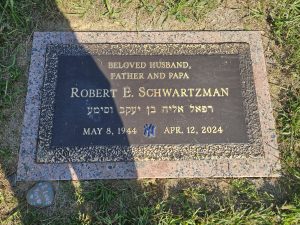
We arrived at “Robert E. Schwartzman. רפאל אליה בן יעקב וסימע Raphael Elijah ben Yaakov v Simma. May 8, 1944-April 12, 2024.” Beloved husband, father and papa. Generations from now, if the world hasn’t been destroyed or the cemetery paved over, future mourners will encounter those words, telling them almost nothing about a man who once lived.
Done. At this point, all we had to do was wait for the stone to be crafted, for the winter months to pass and, sometime around the year anniversary of my father’s death, hold a short unveiling ceremony.
Not quite.
“I was thinking of putting the Yankee logo on his headstone,” my mother revealed during one of our now near-daily calls.
“What?”
The Yankee logo? It’s not like my dad played for the Yankees. It had been years since he’d been to the stadium, mostly because he was incapable of getting to his seat without a wheelchair and he wasn’t going to be wheeled around the house that Ruth built in public. The Yankees are business, a private company; the organization’s goal is not to uplift the lives of its fans but to make money. Isn’t the gravestone sacred? I imagined the logo swallowing everything else, turning my father’s headstone into a billboard.
Then, there’s the manner of location. It’s not that the Yankees and Phillies are bitter rivals. But this is Phillies country—and it’s a sport obsessed town. Wouldn’t sticking a Yankees logo on a tomb in the middle of a Philly-area cemetery be a provocation to all those dead souls lying in the ground or the living who come to pay their respects? Could the symbol offend the very earth itself?
I said something like this to my mother.
She responded, “Think about it, it will bring a smile to your face every time you visit.”
Every time? How much time did my mother expect me to hang out in a cemetery a half hour from my home? Once a year? There’s no winning an argument with my mother once she sets her mind to something. If she wanted a Yankee logo, I wouldn’t try and stop her. Would it really bring a smile? I imagined that whenever I’d visit this cemetery, I’d be reminded that my father didn’t live to see his 80th birthday or either of his granddaughters become a bat mitzvah. That I’d never be able to call him again and that whatever I hadn’t managed to say would remain unsaid, and whatever I’d done to wound him over all the years that I yelled and rebelled would go unatoned. I imagined the cemetery to be a negative space, a reminder of absence and no symbol could change that.
It seemed unlikely to happen anyway. The Yankees and Major League Baseball must grant approval for any official usage of their logo. Whoever chiseled the stone or supervised the artisan needed written permission to engrave a symbol protected by copyright.
“You’re not going to bother with that, right?”
“Why not?” my mother asked.
“It just sounds like such a hassle.”
She had never lived on her own, balanced a checkbook, paid the bills. Now, she had to deal with retrieving my father’s IRA funds and managing the affairs of two houses and, for now, three cars. She had no folder with all her finances and payments. No master password list. She had so much to figure out. Was she going to waste energy on getting permission from the Yankees and MLB?
When my mother sets her mind to something, she doesn’t stop. She might not have seen to my father’s burial, but she was going to adorn his final resting place in Yankee blue. She wrote and called, called and wrote and, with persistence, got permission.
**
We gathered in early May to unveil my father’s headstone. Only about 15 people in all, close friends and family who’d missed the funeral, including his older brother who I hadn’t seen in close to 30 years. While I spoke for close to half an hour at the funeral a year before, on this day I’d remain mostly silent, in part because I was suffering from bronchitis and in part because the weight of loss had only grown heavier.
I approached the stone for the first time. The Yankee logo was small, tucked at the bottom, almost tasteful. The blue seemed brilliant, bringing color to the gray of absence. And the fact that the rabbi presiding over the short service was a lifelong Met’s fan, well, I’ll say it, my mother was right. I smiled.
It’s traditional to visit the graves of loved ones before the High Holidays, when the Book of Life is opened and the liturgy tells us that our fates for the coming year are inscribed—with the caveat that the actions of repentance, prayer and charity temper severe decrees. Several months after the unveiling, my mother and I took a drive out from my house on a Sunday, a few weeks before the Jewish New Year. We’d argued, because I’d wanted to take my car. My mother insisted that we take her car, that she didn’t want to waste mileage and gas on mine.
I wore my Derek Jeter jersey and Yankee hat. A friend had given me the jersey because it no longer fits him; I hadn’t worn it much because I find the shirt too warm for hot days and not warm enough for the cold.
Before we arrived, I wondered if my mother or I would talk to the ground, offer a monologue of everything we’d wanted to say to my father for months but hadn’t, as if he could only hear us here but nowhere else on Earth. We each said a couple things; the girls are well, we missed him. Mostly we talked to each other, the way we had while he slept in the ICU. She rested on me, her back had grown weaker and she would soon have a procedure to block pain receptors. The sky was brilliant and blue, the grass green, one could almost imagine it was like the grass at Yankee stadium. We saw blue birds flying in the distance. My mother picked up a leaf and wondered what kind of tree it had fallen from. She’d take it home and look it up later. For now, there was something like peace and we didn’t want to ruin it.
_________
Bryan Schwartzman is an award-winning journalist whose fiction has been nominated for the Pushcart Prize. His stories have appeared in the Saturday Evening Post, Judith Magazine, Books N’ Pieces and elsewhere. He is a frequent book critic for Hadassah Magazine. Raised in New York City, he lives outside Philadelphia.
Wow this was AMAZING!
After quietly reading Bryan’s heartfelt memories of Robert, through my tears of remembrance ( since I was on the phone with both Jane & Bryan) at the time they were in the icu, it brought back memories of losing my father who I never had a chance to say goodbye. It’s a beautiful memorial and cathartic cleansing to expose your feelings in writing for the public’s eye. Bravo and I hope as the years pass, each memory will be a blessing.💙🙏💋. Linda
Bryan this was oh so beautiful! Uncle Bob would have been so proud of you! This story was penned beautifully! He truly did love his granddaughters. Thank you for sharing him with us. He will forever be missed. He was the best mentor anyone could ever have! Much love to you and Amy and the girls and to Jane. Xoxo
A touching, thoughtful tribute. A reminder about what is sacred and fragile in life. A great read.